A memory on memory
An excerpt from my autofiction novel in progress

As some of you may know, I’ve been working on a novel. The project uses real excerpts from a memoir my dad was writing before he passed, which is bringing up a lot of strange and interesting memories and theories as I write around them.
For my first Substack post, I’m sharing a section that happens to be completely nonfiction, because why not? This section is responding to my father’s writing about a Japanese-language speech contest that I participated in as a high school student.
My speech was about my great-grandmother, who had Alzheimer’s disease. Born in Strasbourg around the start of the twentieth century when the city was still under German rule, my great-grandmother had a traumatic childhood that was shaped by famine conditions of the First World War. At one point, my father told me (back when I was gullible as they come), she even had to eat lightbulbs and scrap metal.
When I was writing the speech she was in her late nineties and could no longer hold a conversation. She would start a sentence, begin to stutter, utter some slurry of sounds on the spectrum between German and English, and give up on trying to express herself. She’d slump down quietly with an expression of defeat for a few seconds until suddenly, she was reset to factory settings. She’d sit back up and smile back at the faces of the kindly strangers (family) around her. I was just old enough to realize the weight of what was lost. In the earlier years of her disease, when she was still able to tell a story all the way through, I’d just found her irritating. This frail woman with a thick German accent kept telling the same stories from her childhood over and over again. Her favorite stories to tell were of growing up in Heidelberg. She frequently snuck into Heidelberg Castle with her cousin, whose father was a stonemason there. Once, she crept in during a performance of “Wilhelm” Shakespeare’s A Midsummer Night’s Dream. Decades later she named one of her dogs “Puck.” Another time, she and the cousin were caught by a handsome guard, who, instead of kicking them out, showed them around.
She was always so excited to have me as her captive audience. I was too young and ungrateful then to appreciate what a wonder her life was. What I remember clearly are not the contents of her memories, but an outline of her as a character in my life. Like her old lady smell, the translucency of the skin on her face, and how I would pretend to listen after the trillionth time of telling her, “Yes, you already told me that one.” She owned a German Shepherd named Wolfie, whom she’d bring on short hikes through the woods behind her Nutley, New Jersey home––well into her eighties. Every day she’d pull out a terracotta clay jar with turquoise arabesque detailing, and grab from it a handful of bittersweet chocolate chips, which she’d eat while playing a game of solitaire at the dining table. The secret to living to 100 years old? Chocolate.
Much later, as an adult, I learned the incredible story of her struggles in America, which put her pre-Alzheimer’s irascibility into perspective. Long after her passing, I had asked my great-uncle about the crucifix on the wall in the house in New Jersey. Was the family’s escape to the States due to fear of persecution for being Catholic? I’d asked. No, no, we weren’t Catholic, he said. Well she was, but she wasn’t.
As it happened, early on during the Second World War, my great-grandfather and great-grandmother were living in Switzerland with their three children. My great-grandfather worked for a pharmaceutical company as a chemist, and though Switzerland was a relatively safe place in Europe to be, Hitler’s invasion of Czechoslovakia––where my great-grandfather was born and raised (his father was Jewish, but had married a non-Jew and raised his son secularly)––had sent the continent into a panic. A representative from the company, known then as Hoffman-LaRoche, was able to secure visas to the US for my great-grandfather and his family, and they shipped off, away from the carnage. After stowing away with cargo and transiting through Europe, they finally boarded a ship in Lisbon, bound for the US of A, with a brief stop in Havana.
On this boat was a dashing American pianist. My great-grandmother, who herself was a piano teacher, fell instantly in love. She invited the man to board with them in their new home, where he became my great-uncle’s piano teacher. I can’t imagine what her husband thought of this arrangement, but their son made the instrument his career, so he certainly got a quality education. My great-grandmother attempted to seduce the pianist, who rebuffed her advances––he was a Catholic and could not be with a non-Catholic, nor a married woman. Undeterred, she converted to Catholicism and divorced her husband. When she approached him again, now separated from her husband, my great-grandfather, he rejected her once more, saying he could not be with a divorcée.
Many years later, my great-uncle, by then a successful composer, met up with his old piano teacher for dinner. The pianist brought his close “friend”––a handsome man with whom he had been living in the city. My great-grandmother had never stood a chance.
I didn’t know any of that at the time. I wrote my speech because by late high school I had become mature enough to regret taking her stories for granted. I could barely remember them, because every time she spoke to me as a kid, I’d tune them out, thinking, Not this again. By that point, I had learned that my great-grandmother had been a bit of a pariah among the family before her disease. She had ousted various people from her life. She was a bitter and paranoid woman, who accused family members of stealing her silverware and conspiring against her. She cut her son, my composer great-uncle, out of her life because his second marriage was to a woman she could not stand. But a curious thing happened as a result of her illness––she forgot to be angry. And so the family was able to spend the last five years of her life whole, regularly joining together in celebration of holidays. I wrote my speech about this, the peculiar outcome of her disease. By all accounts it was a horrible thing to see a person’s loved one succumb to. But the silver lining of my great-grandmother losing her memories was that the bad ones went along with the good ones; the person who remained had forgotten how to fear and hate. I won first place in the regional contest.
When I delivered the final line of my speech, the audience reacted quite different from my expectation. “I’ll never forget my great-grandmother. Unless I, too, develop Alzheimer’s.” I delivered the line with a straight face, but a number of the audience members laughed. What about that was funny? I had meant it quite literally. I was already genetically predisposed; it was just a matter of time before I would eventually forget her, but as long as I was in control of my faculties, I would remember what I could of the life of this woman who forgot her own life.
I see it now––the humor. The whole tone of my speech was making light of Alzheimer’s. Sure it’s kinda sad that she forgot her entire identity, but at least my family came together! She was, as my dad said, an ogre. Raskolnikov might as well have chosen her as a target instead of the greedy and cantankerous pawnbroker Alyona Ivanova. From a utilitarian standpoint, a majority of people benefited from her illness. I had written about her at her expense. And to top it off, I went and said, “I’ll always remember you! Unless, of course, I forget. Oops!”
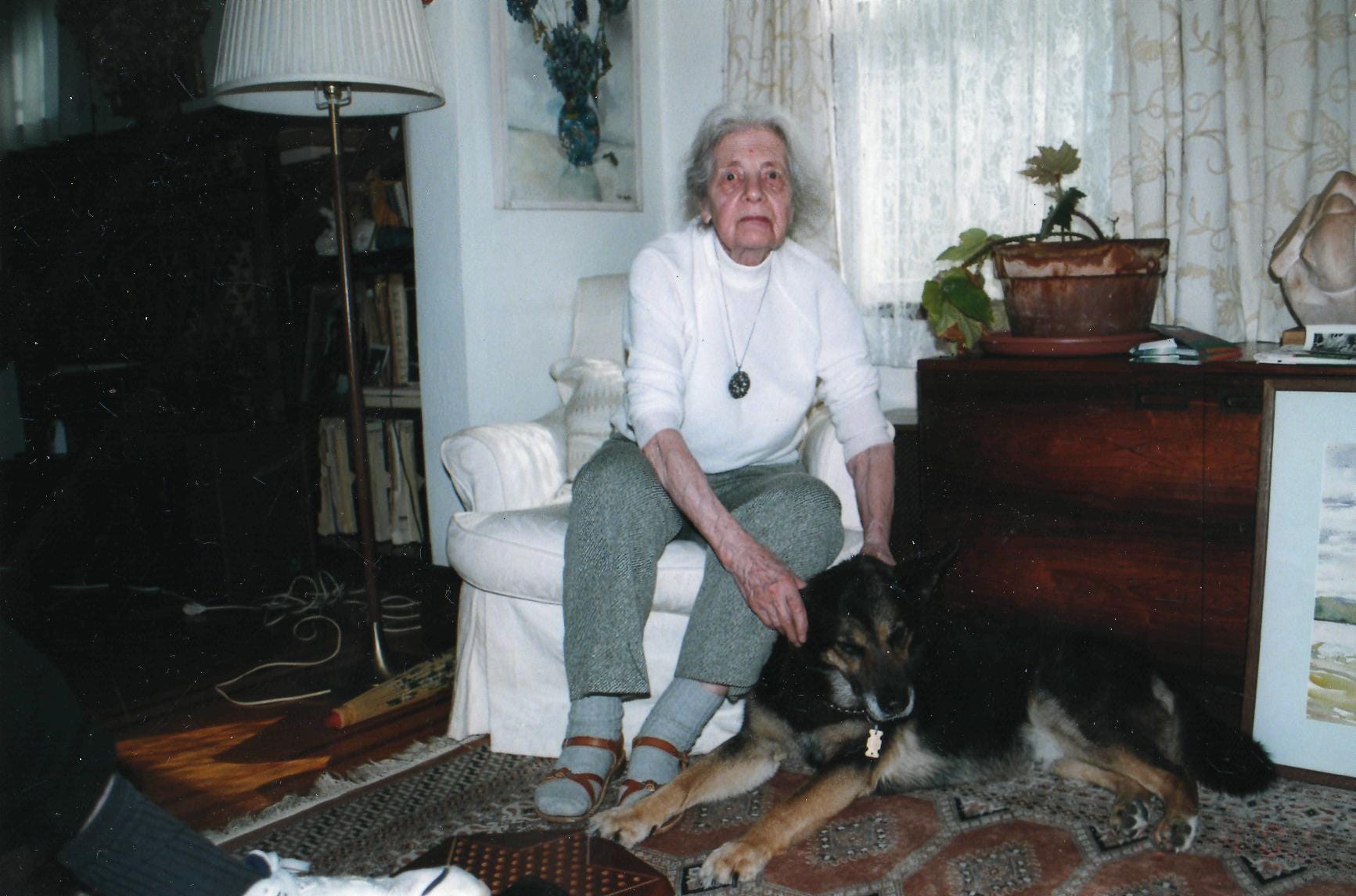
My great-grandmother and her dog, Wolfie
Me giving my speech. This is for evidence only. Please don’t watch it, I was sooo embarrassing at 16 and my intonation is weird.
Such a lovely, bittersweet piece — like chocolate. It’s a privilege to know our elders.
I too live on lightbulbs and scrap metal. What a character!